
Introduction
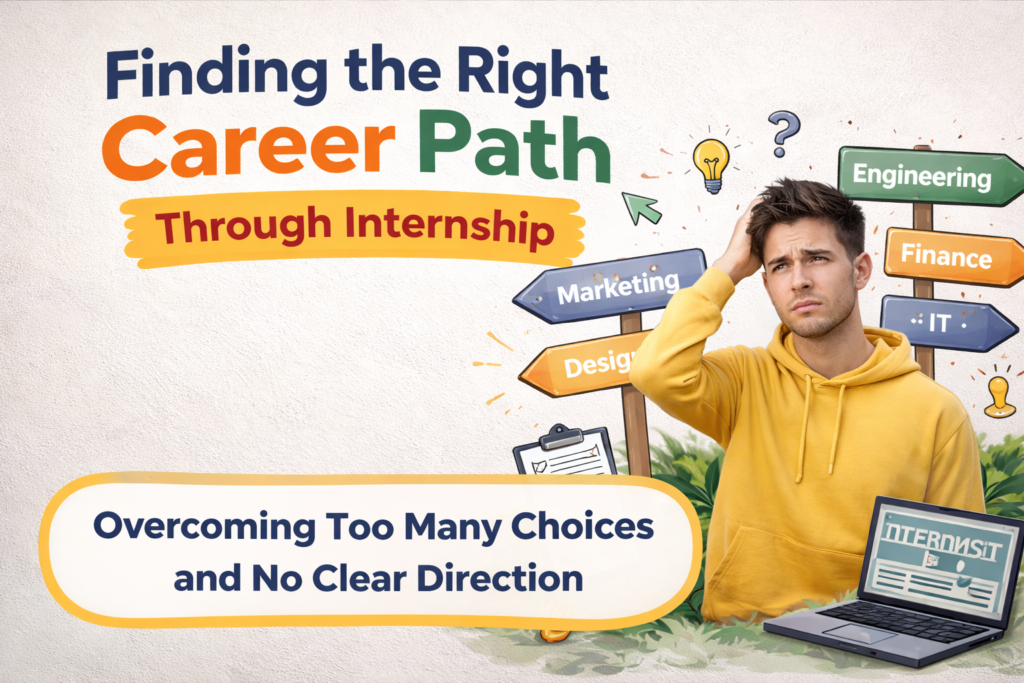
Internships today play a crucial role in helping students navigate a problem that didn’t exist at this scale a decade ago—not a lack of opportunities, but an overwhelming number of them. From web development to AI/ML, cybersecurity to cloud computing, data science to app development—the list feels endless, making it harder than ever to choose the right path.
At first glance, this seems like a good problem to have. But in reality, it often leads to confusion, anxiety, and inaction.
Students find themselves stuck in a loop of watching tutorials, switching between domains, and constantly questioning whether they are on the “right” path. This is where an internship becomes incredibly valuable—not just for skill-building, but for career clarity.
The Problem: Too Many Options, No Direction
The modern learning ecosystem is flooded with choices:
- Web Development
- Artificial Intelligence & Machine Learning
- Cybersecurity
- Cloud Computing
- Data Science
- UI/UX Design
- Blockchain
Each field promises great career opportunities, high salaries, and future growth. Naturally, students feel pressured to choose wisely.
But instead of clarity, this abundance creates:
- Decision paralysis
- Constant doubt
- Fear of missing out (FOMO)
- Lack of consistency
Students often jump from one field to another without gaining depth in any.
The Tutorial Trap
With platforms like YouTube and online learning websites, knowledge is more accessible than ever. However, this accessibility comes with a downside.
Students often:
- Start multiple courses but don’t finish them
- Watch tutorials passively without practicing
- Follow trends instead of interests
- Lack a structured learning path
This leads to the illusion of progress without actual skill development.
An internship helps break this cycle by introducing structure, accountability, and real-world application.
Fear of Choosing the “Wrong” Path
One of the biggest mental barriers students face is the fear of making the wrong choice.
Questions like:
- “What if I choose web development and regret it later?”
- “What if AI is better for the future?”
- “What if I waste my time learning the wrong skill?”
This fear often leads to overthinking and inaction.
The truth is, there is no permanently “wrong” path—only lack of exposure. And the best way to gain that exposure is through an internship.
How Internship Provides Clarity
An internship is not just about gaining experience—it’s about discovering what suits you.
1. Real Exposure to Fields
Instead of guessing, you actually experience what working in a domain feels like.
2. Understanding Your Interests
You may think you like a field, but an internship reveals whether you truly enjoy working in it.
3. Learning What You Don’t Like
Sometimes clarity comes from elimination. Internships help you rule out paths that don’t fit you.
4. Building Confidence in Decisions
Hands-on experience reduces doubt and helps you make informed career choices.
Internship vs Endless Learning
There’s a big difference between learning endlessly and learning with direction.
- Tutorials give information
- Internships give experience
- Tutorials are passive
- Internships are active
- Tutorials are unstructured
- Internships are goal-oriented
While tutorials are useful, they cannot replace the clarity that comes from real-world exposure through an internship.
The Role of Structured Programs
Many students struggle because they don’t have a roadmap. They don’t know:
- Where to start
- What to learn next
- How to apply their knowledge
This is where training cum internship programs become extremely helpful. They provide:
- A clear learning path
- Practical assignments
- Real-world projects
- Mentorship and guidance
One such program is offered by LetsIntern:
👉 https://letsintern.in/current-internships/
This training cum internship program helps students move from confusion to clarity by combining structured learning with hands-on experience.
How to Use Internship to Find Your Path
If you’re unsure about your career direction, here’s how you can use internships effectively:
1. Start Early
Don’t wait until your final year. Explore different fields through internships as early as possible.
2. Experiment
Try internships in different domains to understand what suits you best.
3. Reflect
After each internship, ask yourself:
- Did I enjoy the work?
- Was I curious to learn more?
- Can I see myself doing this long-term?
4. Focus Gradually
Once you find a field that interests you, start going deeper into it.
Common Mistakes Students Make
Even with opportunities available, students often make mistakes such as:
- Following trends instead of interests
- Switching fields too quickly
- Avoiding real-world experience
- Relying only on tutorials
An internship helps avoid these mistakes by grounding your learning in reality.
Building a Clear Roadmap
Clarity doesn’t come from thinking—it comes from doing.
A simple roadmap could be:
- Explore different fields through basic learning
- Take up an internship in one domain
- Evaluate your experience
- Try another internship if needed
- Choose a direction based on real exposure
- Deep dive into that field
This approach is far more effective than endlessly consuming content.
The Confidence Factor
One of the biggest benefits of an internship is confidence.
When you work on real projects, solve real problems, and contribute to actual outcomes, you start believing in your abilities. This confidence helps you:
- Make better decisions
- Perform well in interviews
- Stand out among peers
Conclusion
Having too many choices is not a disadvantage—if you know how to navigate them. The real problem is not the number of options, but the lack of direction.
An internship provides that direction. It transforms confusion into clarity, hesitation into action, and doubt into confidence.
Instead of overthinking your career path, start exploring it through real experiences. Use internships as a tool to discover your interests, build skills, and make informed decisions.
If you’re feeling lost, remember this:
You don’t need to have everything figured out—you just need to take the first step.
And often, that step begins with an internship.