
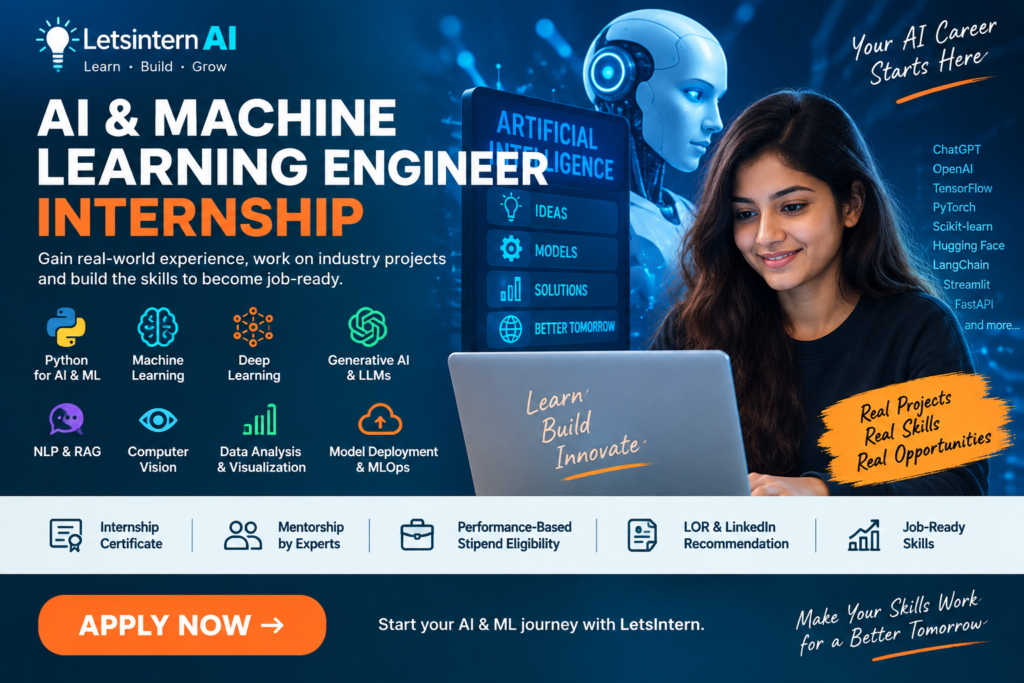
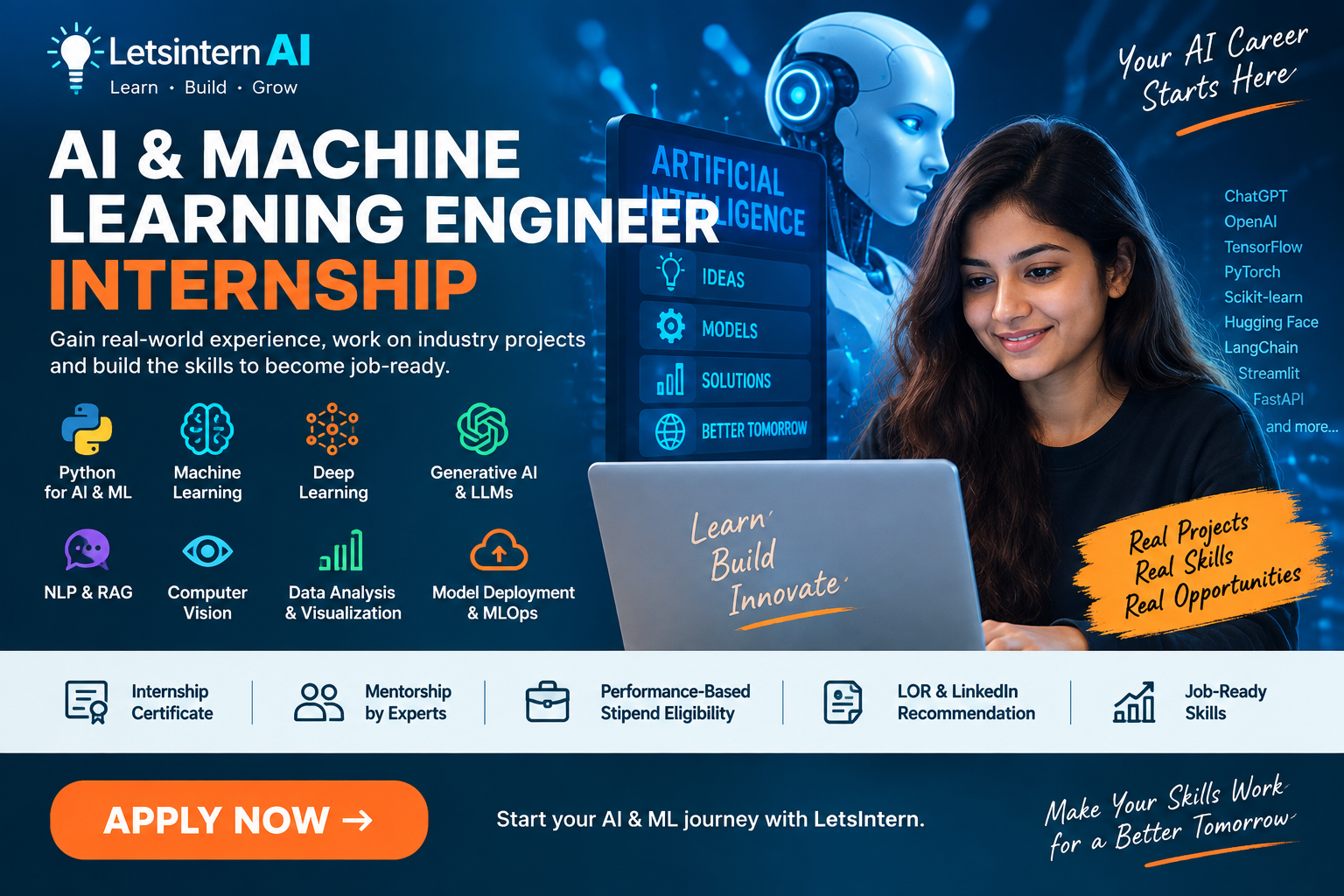
Artificial Intelligence and Machine Learning are transforming almost every industry, from healthcare and finance to education, cybersecurity, e-commerce, and software development. For students, freshers, and working professionals, learning AI concepts is important—but building practical projects is what helps turn knowledge into job-ready skills.
An AI & Machine Learning Engineer Internship gives learners an opportunity to work with Python, data preprocessing, machine learning algorithms, deep learning, natural language processing, generative AI, and model deployment. Instead of only watching tutorials, interns can practice solving real-world problems, document their work, and build a portfolio for future AI and data science roles.
What Does an AI & Machine Learning Engineer Do?
An AI and Machine Learning Engineer develops systems that learn from data and produce useful predictions, classifications, recommendations, or automated responses. Typical responsibilities include collecting and cleaning data, selecting algorithms, training models, evaluating performance, improving accuracy, and deploying models into usable applications.
- Prepare and clean structured and unstructured datasets.
- Build regression, classification, clustering, and recommendation models.
- Work with neural networks and deep learning frameworks.
- Develop NLP, chatbot, computer vision, and generative AI solutions.
- Test models using suitable evaluation metrics.
- Deploy AI applications through APIs, dashboards, or cloud platforms.
- Use Git and GitHub for version control and project collaboration.
Why Choose an AI & Machine Learning Internship?
A structured internship helps connect academic learning with practical engineering workflows. You can understand how an AI project moves from an idea to data preparation, model development, testing, deployment, and documentation.
1. Learn Python for AI and Data Science
Python is widely used in machine learning because of its readable syntax and extensive ecosystem. During practical training, learners can work with NumPy, Pandas, Matplotlib, scikit-learn, and Jupyter Notebook or Google Colab.
2. Understand Machine Learning Fundamentals
Build a foundation in supervised and unsupervised learning, regression, classification, clustering, feature engineering, train-test splitting, overfitting, underfitting, and model evaluation.
3. Explore Deep Learning and Neural Networks
Learn the basic ideas behind neural networks, CNNs, RNNs, LSTMs, and deep learning workflows using tools such as TensorFlow, Keras, or PyTorch.
4. Practice NLP, Generative AI, and Computer Vision
Modern AI projects may include sentiment analysis, text summarization, chatbots, image classification, embeddings, transformers, and applications powered by large language models such as GPT or BERT-based systems.
5. Learn Model Deployment and MLOps Basics
A model becomes more valuable when people can use it. Internship projects may introduce Streamlit, Flask, Hugging Face Spaces, Render, Vercel, cloud storage, APIs, model versioning, and introductory MLOps practices.
Real-World AI and Machine Learning Projects You Can Build
Project-based learning is one of the strongest ways to demonstrate your ability to employers. Example projects include:
- AI-Powered Virtual Assistant: Create a conversational assistant using NLP, APIs, and transformer-based models.
- Image Classification System: Train a computer vision model to classify images using a suitable dataset.
- Customer Support Chatbot: Build a rule-based or NLP-powered chatbot for common customer questions.
- Sentiment Analysis Web App: Classify text as positive, negative, or neutral and present results through a simple interface.
- Fake News Detection Model: Use text features and machine learning algorithms to classify news content.
- Loan or Sales Prediction System: Apply data preprocessing, feature engineering, regression, and evaluation techniques.
- Recommendation System: Recommend products, movies, or learning resources using similarity or collaborative filtering.
- Text Summarization Tool: Develop an extractive or transformer-assisted summarization application.
Skills Covered in an AI & Machine Learning Engineer Internship
A well-structured program can cover the following areas:
- Python programming for AI
- NumPy, Pandas, Matplotlib, and data visualization
- Data cleaning, exploratory data analysis, and feature engineering
- Supervised and unsupervised machine learning
- Regression, classification, clustering, and dimensionality reduction
- Model training, testing, validation, and performance evaluation
- TensorFlow, Keras, or PyTorch fundamentals
- NLP, tokenization, embeddings, transformers, and text classification
- Generative AI concepts and AI application development
- SQL, MongoDB, and data storage basics
- Git, GitHub, APIs, and project documentation
- Streamlit or Flask deployment and introductory MLOps
Who Can Apply?
The internship is suitable for final-year students, graduates, freshers, computer science learners, engineering students, data science aspirants, and working professionals who want practical exposure to AI and machine learning. Beginners can start with foundational guidance, while experienced learners can use the projects to strengthen their portfolios.
What Can You Gain from the Internship?
Depending on the program structure and successful completion of assigned work, participants may gain practical project experience, mentor feedback, an internship certificate, a Letter of Recommendation where applicable, project documentation, and career guidance. Always review the program terms, eligibility requirements, stipend conditions, and deliverables before registering.
How to Apply for the AI & Machine Learning Internship at LetsIntern
If you want to start building practical AI skills, explore the official internship page and complete the registration process. You can select your preferred internship duration and provide your academic or professional details through the application form.
Apply Now for the AI & Machine Learning Internship
Final Thoughts
Becoming an AI & Machine Learning Engineer requires more than memorizing algorithms. You need practice with data, models, evaluation, deployment, teamwork, and problem-solving. A project-based internship can help you develop these capabilities step by step and create evidence of your skills through meaningful portfolio projects.
Start with Python and data handling, strengthen your machine learning fundamentals, explore deep learning and generative AI, and keep building. Consistent hands-on practice is the foundation of a successful AI career.